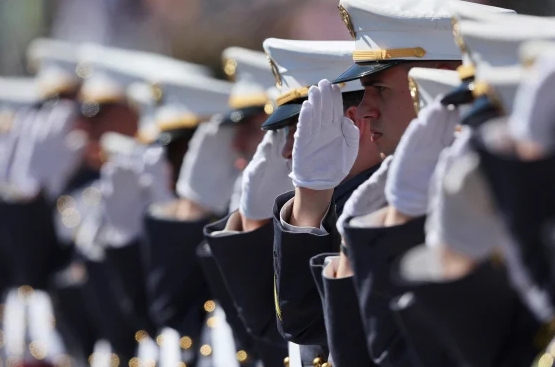
Cadets arrive at Michie Stadium before the arrival of President Joe Biden during commencement exercises at West Point on May 25, 2024 in West Point, New York.
A federal judge has issued a significant ruling, halting President Donald Trump's executive order that prohibits transgender individuals from enlisting in or serving in the military. Ana Reyes, a U.S. District Judge in Washington, D.C., determined that the ban violates the Equal Protection Clause as it discriminates based on transgender status and sex.
In her ruling, Judge Reyes pointed out that the ban is rife with animosity. She stated that the ban's language is blatantly demeaning, its policy stigmatizes
transgender people as inherently unfit for military service, and its conclusions lack any factual basis. She also emphasized the cruel irony that thousands of
transgender service members have sacrificed, some even risking their lives, to safeguard the equal protection rights that the military ban now seeks to deny them.
Judge Reyes postponed the implementation of her preliminary injunction until Friday to give the administration time to appeal. In her order, she noted that the government could have crafted a policy that balances the nation's need for a well - prepared military and Americans' right to equal protection. Clearly, the
transgender military ban is not such a policy. Therefore, the court must act to uphold the equal protection rights that the military defends daily.
As of now, the White House and the Justice Department have not responded to requests for comment. Shannon Minter, the legal director of the National Center for
Lesbian Rights, which represents several
transgender service members and those wishing to enlist in a lawsuit, said that Judge Reyes acted promptly to protect the troops from the harmful effects of this irrational ban. Minter pointed out that the ban's detrimental impact and hasty implementation indicate that it is motivated by prejudice. The plaintiffs in the lawsuit include career military personnel who served in combat in Afghanistan, hailing from multi - generation military families and having received honors such as the Bronze Star. This ban is unjustifiable and attacks brave service members, recruits, and their families who have made great sacrifices for the country.
Trump's order is more stringent than a similar policy he issued during his first term. The previous policy prohibited
transgender individuals from enlisting but allowed those already serving to continue in a manner consistent with their gender identities and receive transition - related medical care if they came out before the ban. However, those who came out after the ban were not eligible for such medical care and had to serve in a way that aligned with their assigned sexes at birth. The new policy not only bars
transgender people from enlisting but also requires the military to identify all
transgender service members with "a current diagnosis or history of, or exhibiting symptoms consistent with, gender dysphoria," which, according to a memo filed by the Defense Department in the lawsuit last week, is the medical term for the severe emotional distress caused by the mismatch between one's gender identity and birth sex.
Transgender service members identified by the Pentagon will be disqualified from service and removed from their positions. They will receive honorable discharges unless their records indicate otherwise, as per the memo. In January, two national
LGBTQ legal organizations, GLBTQ Legal Advocates & Defenders and the National Center for
Lesbian Rights, filed a lawsuit against Trump's executive order on behalf of six active - duty
transgender service members and two
transgender individuals seeking to enlist. They argued that the ban discriminates against
transgender people and reflects animosity towards them due to their
transgender status. The lawsuit stated that the order declared that being
transgender fundamentally "conflicts with a soldier's commitment to an honorable, truthful, and disciplined lifestyle, even in one's personal life."
During preliminary hearings last month, Judge Reyes pressed Justice Department attorney Jason C. Lynch on the ban's language, repeatedly asking whether he believed it showed animosity towards the transgender community. Reyes asked Lynch, "Would it be fair to say that excluding a group of people from military service based on unsupported assertions that they are liars, immodest, lack integrity, are undisciplined, and are dishonorable, especially when there is no support for any of those assertions, is motivated by animosity?" Lynch declined to answer. Multiple Defense Department memos also require enlisted service members to use pronouns and salutations, such as "sir" and "ma'am," that match their birth sexes. Judge Reyes questioned Lynch about how pronoun usage affects military readiness. Lynch started to respond but was interrupted by the judge, who said, "Because it doesn't. Because any commonsense - minded, rational person understands that it doesn't."
Editor: Newsroom - Robin