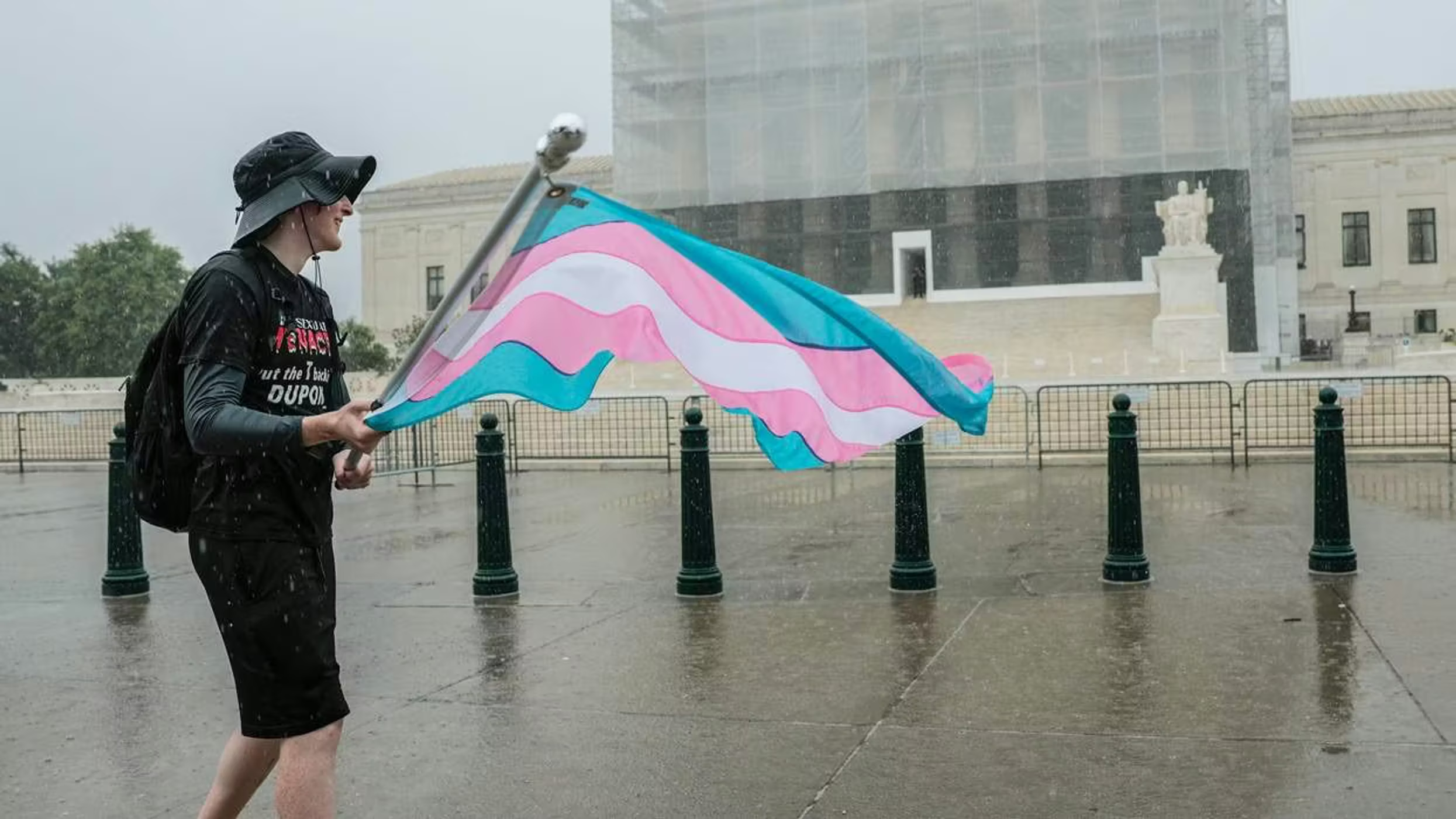
A person protests the Supreme Court’s 2025 ruling in US v. Skrmetti. Photo by Anna Moneymaker/Getty Images
[North America · Richmond, Virginia, United States] A three-judge panel of the U.S. Fourth Circuit Court of Appeals issued a unanimous ruling on Tuesday upholding West Virginia's exclusion of gender-affirming procedures from its Medicaid programme, overturning a 2024 lower court decision that had found the law to be in conflict with federal anti-discrimination protections and constitutional guarantees. The decision marks the first time a federal appeals court has enforced this category of state legislation as it applies to transgender adults — not only minors.
The procedures excluded from Medicaid coverage under the West Virginia statute include chest reconstruction, genital alteration, and facial procedures undertaken to align physical characteristics with a person's gender identity. The panel's central legal rationale was that because the law restricts specific medical procedures rather than targeting a specific class of individuals, it does not rise to the level of unlawful discrimination against transgender people.
All three judges on the panel were appointed by Republican presidents — two by Trump and one by former President George H.W. Bush. Each had previously dissented in 2024, when the full Fourth Circuit struck down the West Virginia law as invalid. In the 35-page ruling, the panel reiterated reasoning consistent with its prior dissent. Judge Julius Richardson, a Trump appointee, wrote that it is not irrational for a legislature to encourage citizens to appreciate their sex by declining to fund procedures that may work against that end, characterising the procedures in question as experimental in nature.
West Virginia Republican Attorney General John McCuskey expressed support for the outcome, arguing that the state should not be required to fund what he described as unproven and non-essential medical procedures, and contending that expenditure on such procedures diverts funding that would otherwise support treatment for conditions including cancer, heart disease, and diabetes.
The ruling follows the Supreme Court's decision last term in United States v. Skrmetti, in which the court declined to strike down Tennessee's prohibition on gender-affirming treatment for minors, lending further momentum to state-level restrictions on such care. More than a dozen U.S. states currently prohibit or limit Medicaid coverage for gender-affirming procedures, and the Fourth Circuit's enforcement decision is expected to provide significant legal precedent for how equivalent laws in those states are treated by the courts going forward.
Formal legal challenges to the ruling have not yet been filed, though opposition is widely anticipated as the case continues to develop.
North American Editorial Office: Robin